𝐇𝐮𝐦𝐚𝐧-𝐂𝐞𝐧𝐭𝐞𝐫𝐞𝐝 𝐀𝐈 𝐟𝐨𝐫 𝐏𝐞𝐫𝐬𝐨𝐧𝐚𝐥𝐢𝐬𝐞𝐝 𝐇𝐞𝐚𝐥𝐭𝐡𝐜𝐚𝐫𝐞
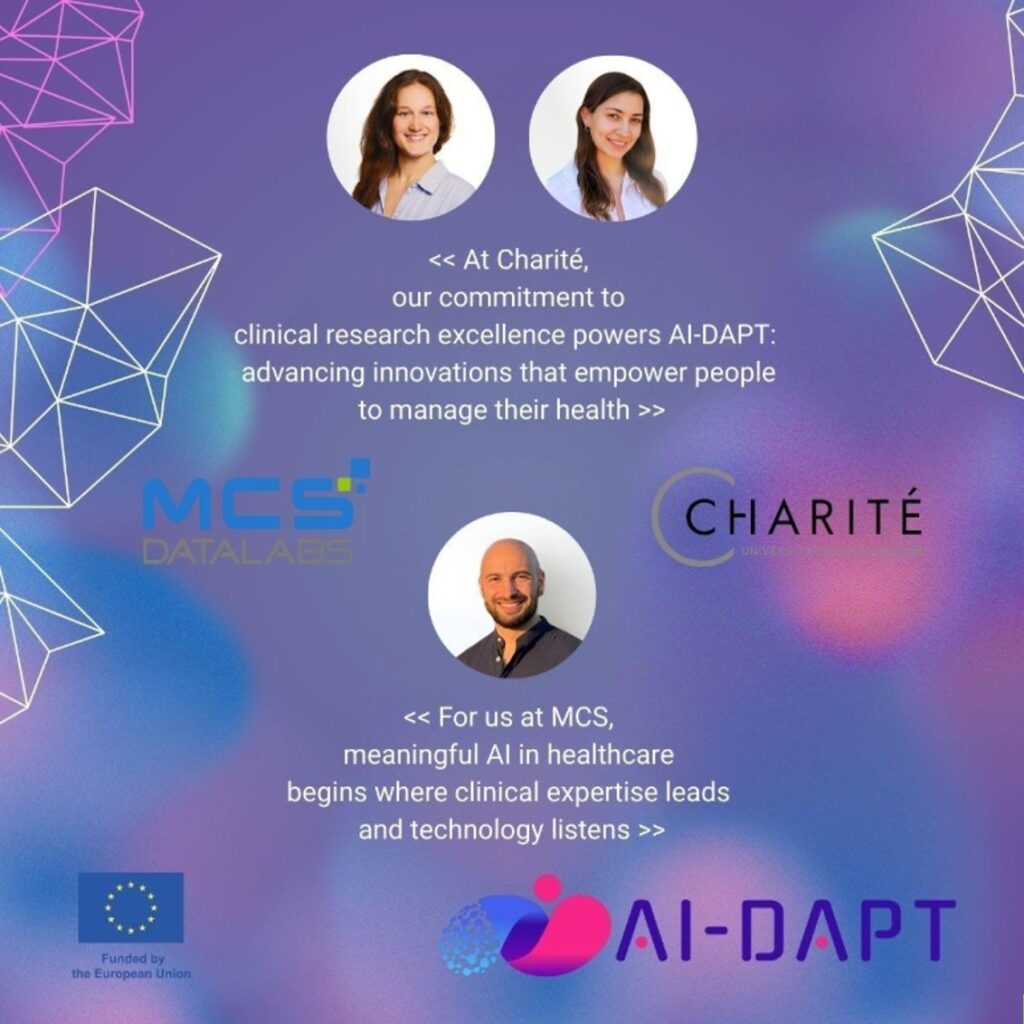
Within the AI-DAPT EU Project, the Health Demonstrator MCS Datalabs in collaboration with Charité Universitätsmedizin Berlin is driving Demonstrator 1 – Personalized Medicine based on Non-Invasive Glucose Monitoring, with a strong focus on human-centred, trustworthy AI.
The demonstrator addresses a critical healthcare challenge. Enabling continuous, non-invasive glucose monitoring that adapts to the individual patient, while keeping clinicians and patients in the loop.
By combining wearable sensor data (such as photoplethysmography signals) with clinical and contextual information, the health use case aims to build an AI-ready pipeline for personalised glucose estimation. A human-in-the-loop approach ensures that medical expertise guides data interpretation, model validation, and decision-making – supporting safety, trust, and clinical relevance.
But what are we really talking about?
How do Ai and medical knowledge work together?
The Health Demonstrator combines an end-to-end AI pipeline with science-guided models that embed physiological and medical knowledge. Wearable signals and clinical data are continuously collected, quality-checked, harmonised, and analysed, while domain expertise constrains and guides the learning process. This ensures that AI predictions are not only data-driven, but also physiologically meaningful, explainable, and clinically trustworthy.
Who benefits from this and why does it matter?
People living with diabetes, as well as clinicians supporting them, benefit from more continuous, non-invasive insight into glucose dynamics. Instead of relying solely on sporadic or invasive measurements, wearable-based monitoring can reveal trends, variability, and early warning signs – helping patients better understand their condition and enabling clinicians to make more informed, timely decisions. The result is improved disease management, reduced burden for patients, and support for long-term wellbeing.