
AI-DAPT Advances Towards Final Validation
The AI-DAPT consortium meets on 21–22 October 2026 in Vilanova i la Geltrú, Spain, to review pilot feedback, assess the performance of its demonstrators, address outstanding technical challenges and coordinate the activities leading to the project’s final validation phase.
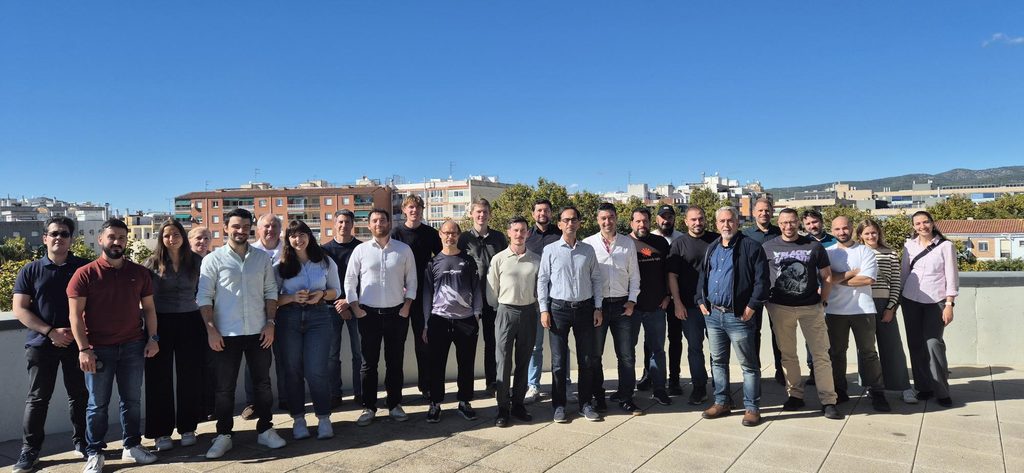
As AI-DAPT approaches the final stages of its implementation, the consortium is focusing on an essential question: how well do the project’s developments respond to the needs and requirements identified through its pilot activities? The 6th Plenary Meeting brings partners together to evaluate progress across the project, examine practical experiences with the AI-DAPT platform and its components, and identify the improvements needed to consolidate the project’s results.
Over two days, discussions are centred on the four demonstrators — health, manufacturing, energy and robotics — which provide the practical scenarios for assessing the platform’s capabilities and the tools developed throughout the project. By reviewing the work carried out within each demonstrator, partners aim to establish a clear picture of current achievements, remaining limitations and the actions required before the final validation activities.
Evaluating the demonstrators and gathering pilot feedback
A central focus of the meeting is the detailed assessment of the four demonstrators and the feedback gathered from their activities. Partners are presenting their experiences using the AI-DAPT platform to perform tasks related to their respective pipeline scenarios, including the use of standalone components and DAVE operators.
These sessions provide an opportunity to examine how the developed tools perform in practical settings and to identify bottlenecks that may affect their application. Partners are also discussing the challenges encountered during implementation, helping the consortium understand where additional refinement or clarification may be necessary.
The review covers the health demonstrator, led by CHARITÉ and MCS; the manufacturing demonstrator, led by BIBA; the energy demonstrator, led by ZENITH; and the robotics demonstrator, led by MADE. Each team is presenting its progress and participating in discussions to assess the current state of its pipelines and the evidence available to support the validation of results.
This exchange of feedback is particularly important as the project moves closer to its final validation phase. Understanding the strengths and limitations of each demonstrator will help partners prioritise the remaining work and ensure that the final assessment reflects the capabilities of the platform in the scenarios for which it has been developed.
Strengthening data readiness and performance validation
Alongside the assessment of the demonstrators, the meeting addresses the data and evaluation processes required to demonstrate the project’s achievements.
Partners are reviewing the availability and characteristics of the datasets used in their demonstrations, including relevant data fields, dataset sizes and supporting information maintained through GitLab. These details are essential for documenting the conditions under which the pipeline scenarios are executed and for ensuring that the validation activities can be properly understood and reproduced.
Another key topic is the revision of the demonstrators’ Key Performance Indicator (KPI) tables, taking into account comments received during previous reviews. The discussions focus on clarifying baselines, identifying the datasets and pipelines used to verify the KPIs, and addressing any outstanding questions concerning the evaluation methodology.
Establishing a clear relationship between the available data, the implemented pipelines and the indicators used to measure performance is an important part of preparing for final validation. It allows partners to assess not only whether the tools function as intended, but also how their performance can be demonstrated against the project’s defined objectives.
Identifying bottlenecks and prioritising platform improvements
The findings from the demonstrator sessions will feed into a joint brainstorming session dedicated to pipeline bottlenecks and potential improvements to the AI-DAPT platform.
During this discussion, consortium partners will consider which features may need to be updated, which functionalities remain missing and how the challenges identified across the demonstrators can be addressed. The objective is to establish a shared understanding of the issues that require attention and to coordinate responses across the project’s technical work.
This collaborative approach is particularly relevant as the four demonstrators address different application contexts and operational requirements. Comparing their experiences helps partners distinguish between challenges specific to individual scenarios and issues that may require broader improvements to the platform or its components.
The meeting also includes a dedicated session on Work Package 4 (WP4), led by UBITECH, to discuss responses to the identified pipeline bottlenecks and the corresponding plan. This provides an opportunity to connect the issues raised during the practical demonstrations with the technical actions needed to address them.
By bringing together feedback from across the project, AI-DAPT aims to ensure that the remaining development work is guided by the practical requirements of the demonstrators and the evidence collected through their implementation.
Coordinating the project’s final activities
Preparing for final validation also requires coordination beyond the technical development of the platform. The plenary meeting therefore includes updates on project management and the progress of the different work packages, alongside dedicated discussions on ethics and exploitation.
The ethics session, led by S&D, provides a forum for reviewing the project’s work in this area as it progresses towards completion. In parallel, UNINOVA and WITSIDE are leading discussions on exploitation plans, with a focus on revisiting the approach and aligning it with the project’s results and next steps.
These activities contribute to the broader objective of ensuring that the outcomes of AI-DAPT are appropriately documented, that outstanding tasks are coordinated, and that plans for the use and uptake of the project’s results remain aligned with the developments achieved.
The final discussions and wrap-up session will bring partners together to consolidate the main points raised during the meeting, agree on priorities and coordinate the next steps towards project completion.
Moving towards the final validation phase
The 6th Plenary Meeting represents an important milestone in the transition from development and pilot assessment towards the final validation of AI-DAPT.
By examining the demonstrators in detail, analysing feedback from practical implementation, reviewing the evidence supporting performance indicators and identifying outstanding technical issues, the consortium is working to establish the conditions needed for a robust assessment of the project’s results.
The focus is now on consolidating what has been developed, addressing the challenges identified by the partners and ensuring that the platform and its components can be evaluated against the requirements of the project’s application scenarios.
As AI-DAPT moves towards its final validation phase, the feedback and conclusions emerging from the pilot activities will play a key role in guiding the remaining work and consolidating the project’s contribution to trustworthy, data-driven AI solutions.