
AI-DAPT participated in the European Big Data Value Forum 2026, held in Galway on 30 September and 1 October. Over the two days, the project contributed to the programme through an exhibition booth where participants could discover its tools and latest results, as well as a dedicated session. The session, “AI-Ready Data and Trustworthy Pipelines for Europe’s Next Wave of Industrial AI”, brought together AI-DAPT, the BDVA etami Task Force and representatives from the MANOLO, PANDORA and TURING projects. The discussion focused on a common challenge: how Europe can move beyond isolated AI pilots towards scalable and trustworthy AI operations.
A collaboration built over time
The EBDVF session continued a collaboration developed through a sequence of joint events involving the HORIZON-CL4-2023-HUMAN-01-01 cluster of projects. Across these events at both ADRA and BDVA forums, the projects moved progressively from defining efficient and trustworthy AI towards examining the practical tools, pipelines and organisational conditions required to deploy it.
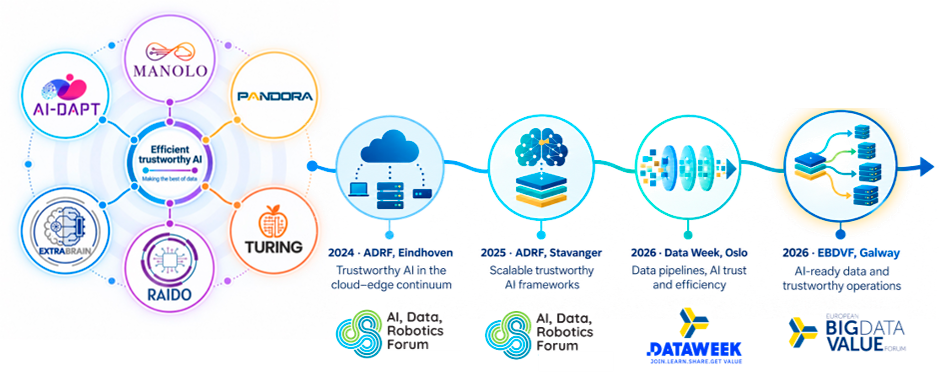
EBDVF 2026 provided the next step in this journey. Rather than treating trustworthy AI as an abstract principle, the session considered how to maintain data quality, model performance, human control and regulatory evidence throughout the complete AI lifecycle.
What AI-DAPT brings
AI-DAPT is developing an open and modular AIOps framework that supports the complete path from raw data to reliable AI models. Its objective is to replace fragmented tools and one-off scripts with reusable, observable and human-governed data and AI pipelines. The framework brings together components for data collection, documentation, cleaning, annotation, synthetic data generation, feature engineering, valuation and observability. These capabilities connect with model training, experiment tracking, explainability, security and model monitoring. Components can be used independently through their own interfaces and APIs or combined as operators within low-code pipelines.
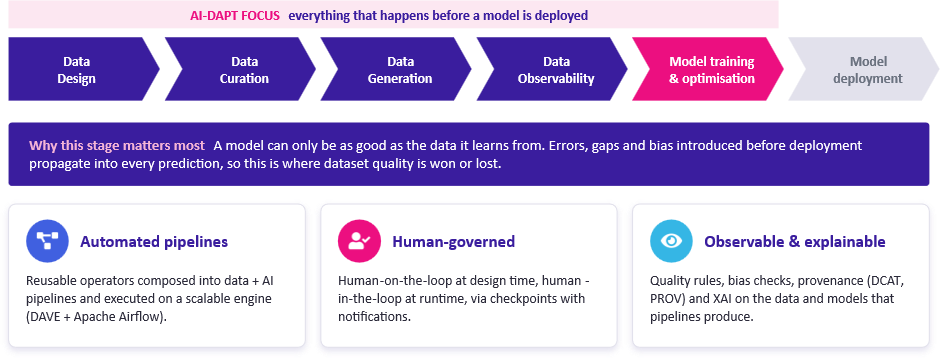
At the centre of this approach is a visual Pipeline Manager built on a scalable execution engine. It allows technical teams and domain experts to assemble workflows, define quality rules, monitor execution and introduce human validation at relevant checkpoints. AI-DAPT also supports hybrid, science-guided modelling, combining data-driven machine learning with domain knowledge and first-principles models. This is particularly valuable when available data is scarce, noisy or subject to physical constraints.
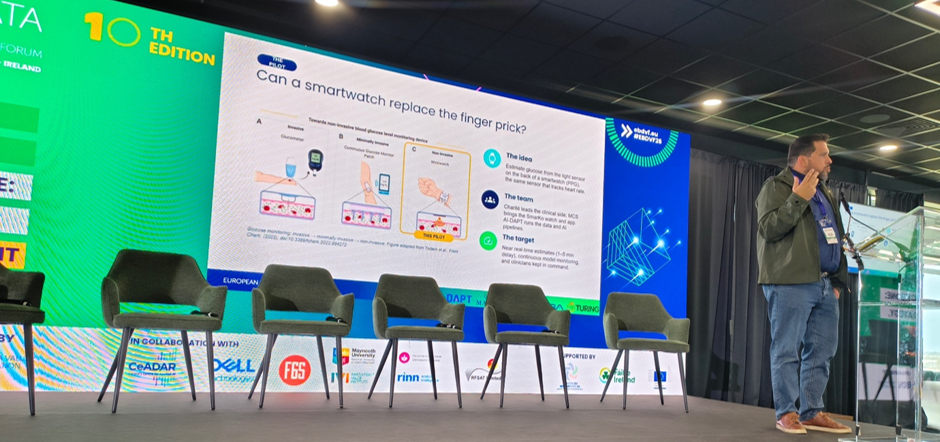
The framework is being validated through pilots in healthcare, energy, manufacturing and robotics. The session explored the healthcare pilot in greater detail, illustrating the challenges of applying AI-DAPT’s approach to noisy, large-scale data collected in real-world conditions. Across these sectors, AI-DAPT aims to make data preparation more reproducible, reduce the effort required to create and maintain pipelines, and provide the traceability and oversight needed to operate AI solutions with confidence.
These capabilities provided the practical foundation for the session’s broader discussion: what is required to move from AI-ready data and experimental models to trustworthy AI systems operating at scale.
Key Takeaways: from AI-ready data to trustworthy operations
The main conclusion emerging from the session and the panel discussion with representatives of AI-DAPT, MANOLO, PANDORA and TURING was that scaling trustworthy AI requires an integrated lifecycle approach. Organisations must prepare fit-for-purpose data, build reusable and observable pipelines, translate regulatory and ethical requirements into measurable controls, and maintain human oversight after deployment.
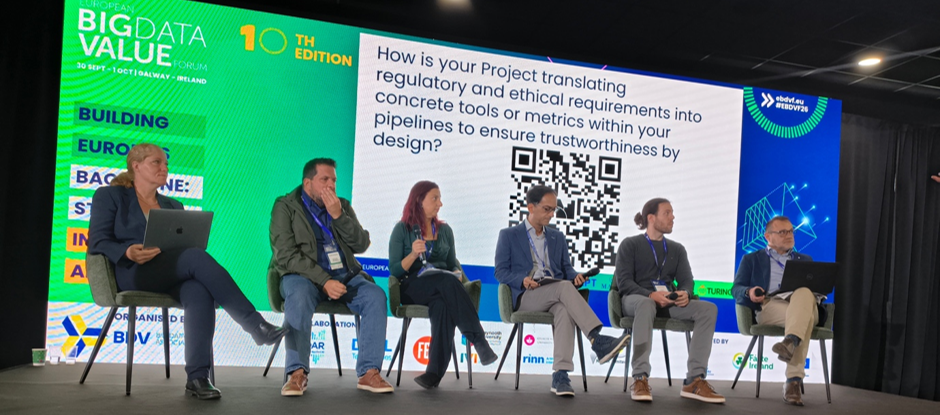
The discussion also situated project-level developments within Europe’s wider AI ecosystem. Several key messages emerged:
- AI readiness extends beyond data availability. Data must have suitable quality, metadata, provenance, interoperability and governance for the intended AI application.
- Trustworthiness must be engineered, evidenced and maintained. Privacy safeguards, uncertainty estimates, robustness tests and acceptance gates should form part of the pipeline. Continuous monitoring must detect changes in data quality, drift and model performance.
- Human oversight must be meaningful and proportionate. High-stakes decisions may require direct human involvement, while routine operations can be monitored by humans with clear authority to intervene. Both approaches depend on explainability and usable interfaces.
- Real-world data changes the problem. AI-DAPT’s healthcare pilot demonstrated how an algorithm that performs well under controlled conditions can behave differently when applied to noisy wearable data. The pilot also generated more than 300 million records, making scalable data processing a fundamental design requirement.
- Data and integration often present greater barriers than algorithms. Fragmented data, scarce labels, legacy systems, incompatible protocols, skills shortages and the lack of common evaluation practices continue to limit adoption.
- There is no one-size-fits-all solution. The participating projects presented complementary approaches involving compliance controls, physics-informed validation, reusable workflows, human oversight and efficiency monitoring.
The session also highlighted the role of the etami Task Force in connecting these approaches, supporting greater alignment between projects and contributing to standards, shared guidance and the wider BDVA ecosystem.
Explore the session presentations on the EBDVF website.
Demonstrating AI-DAPT at the exhibition
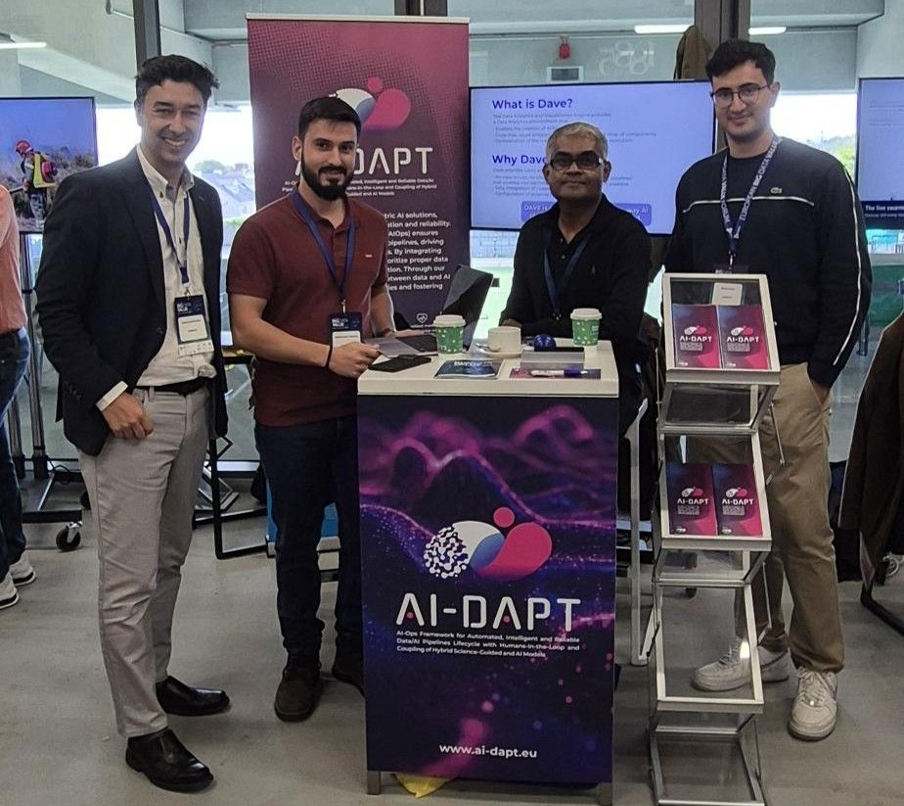
Alongside the session, AI-DAPT maintained a booth throughout the two days of the event. Visitors had the opportunity to learn more about the project’s data-centric AIOps framework and its technical approach. Project partners presented selected solutions through preconfigured demonstrations, allowing visitors to see how AI-DAPT supports activities such as data preparation, pipeline orchestration and the development of trustworthy AI workflows. A selection of videos (check our YouTube channel) provided further insight into the project’s tools and expected impact.
The booth created opportunities to discuss the project directly with researchers, industrial representatives and members of the European data and AI community. These exchanges provided useful perspectives on the challenges organisations face when moving from experimental AI to operational deployment.
Continuing the discussion
EBDVF 2026 confirmed that Europe already has a strong portfolio of tools, methods and real-world experimentation. The next step is to connect these results through interoperable pipelines, shared evaluation practices and governance mechanisms that allow trustworthy AI solutions to be reused and operated confidently across sectors. AI-DAPT will continue contributing to this effort through its technical framework, pilots and collaboration with the wider BDVA community.
Watch the video from EBDVF 2026