Artificial Intelligence is increasingly used to support decision-making in areas such as finance, public services, urban planning, and manufacturing. While these systems can improve efficiency and consistency, they can also unintentionally produce unfair outcomes. One important but often overlooked issue is spatial bias, when model predictions systematically favor or disadvantage individuals, based on their geographic location.
To address this challenge, AI-DAPT incorporates PROMIS, a human-in-the-loop framework for spatial bias detection and mitigation. PROMIS enables users to identify location-based unfairness in AI systems and apply mitigation strategies that improve fairness while preserving predictive performance.
Detecting Spatial Bias
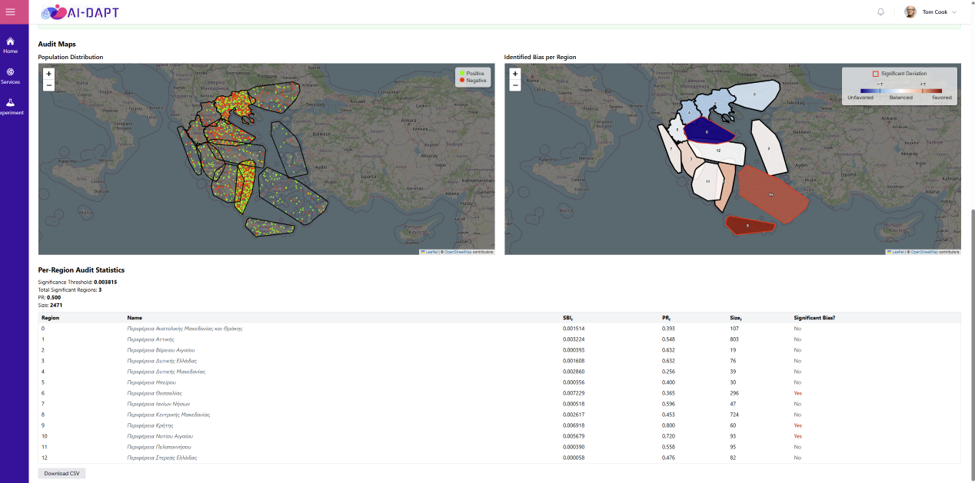
The Spatial Bias Detection component is integrated into the AI-DAPT Data Valuation Engine and acts as a dedicated fairness auditing tool. It analyses model predictions together with geographic information, such as coordinates or region identifiers, to evaluate whether outcomes are distributed fairly across space.
Users can work with predefined regions or generate spatial partitions through clustering and grid-based approaches. The component supports fairness notions such as equal opportunity and statistical parity, providing detailed audit reports and interactive map visualizations that highlight regions exhibiting significant fairness violations.
These insights help users understand where and why spatial disparities occur, supporting more transparent and trustworthy AI systems.
Mitigating Unfair Outcomes
Once bias has been identified, the Spatial Bias Mitigation component helps reduce disparities without retraining or modifying the underlying model. Instead, PROMIS operates as a post-processing framework that can be applied to pre-trained or black-box classifiers.
The mitigation process is formulated as an optimization problem that seeks to minimize spatial unfairness while maintaining model utility. By identifying a small number of targeted prediction adjustments and translating them into region-specific decision thresholds, PROMIS can improve fairness without significantly affecting overall performance.
Importantly, the framework remains effective even in complex spatial settings involving overlapping or irregular geographic regions.
A Human-in-the-Loop Approach
A key feature of PROMIS is that users remain in control throughout the process. Rather than automatically changing model behavior, the platform allows users to:
- audit models for spatial bias,
- inspect fairness metrics and affected regions,
- configure mitigation parameters,
- evaluate fairness-performance trade-offs, and
- review mitigation results before applying them.
This human-in-the-loop workflow promotes transparency and supports informed decision-making when addressing fairness concerns.
From Research to Practice
The mitigation methodology was recently presented at ACM SIGSPATIAL 2025 through the publication PROMIS: A Post-Processing Framework for Mitigating Spatial Bias. The research introduced a novel Spatial Bias Index and an optimization-based mitigation framework that effectively reduces spatial bias while maintaining predictive performance.
Through its integration into AI-DAPT, PROMIS transforms these research advances into a practical capability that helps organizations detect, understand, and mitigate geographic bias in AI systems, contributing to the development of more equitable and trustworthy AI solutions.